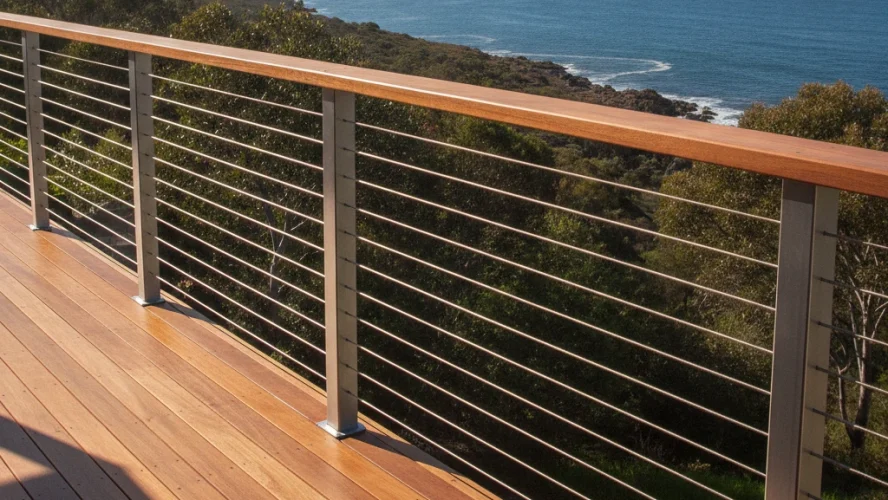
Types of Balustrade Wire Ropes
Written by: Brett Penn, Keble’s Trading Team
Reviewed by: Keble’s Trading Technical Team
Updated: 18 June 2026
TL;DR
- A wire rope balustrade is a tensioned wire infill barrier. The wire is one part of a system that also includes the posts, the top rail, the fittings and the tension. Get one part wrong and the whole barrier suffers.
- Three constructions cover almost every job: 1×19 (stiff, low stretch, best for straight horizontal runs), 7×7 (semi-flexible, handles bends and stairs) and 7×19 (most flexible, more common in marine work). Most balustrade wire is 3.2mm.
- For outdoor and coastal work, grade 316 stainless is the sensible baseline. Grade 304 tea stains near salt air.
- Openings must be small enough that a 125mm sphere cannot pass, which is why most installs run wires around 80mm apart. Where the fall is more than 4 metres, horizontal wires are out and vertical wires are required.
- Compliance comes from measured tension, not from tightening by eye. Have your certifier or engineer confirm the build.
A wire rope balustrade looks simple from the footpath. Straight lines of stainless wire, a clean top rail, an open view. For the builder, fabricator or stair installer putting it in, the wire itself is the easy part. The decisions that decide whether the job holds tension, passes inspection and still looks right in five years sit around the wire: the construction, the grade, the spacing, and how the posts handle the load. This guide walks through those decisions for trade work, and points out where the calls most often go wrong. For the product range behind it, see our wire rope balustrades page.
What is a wire rope balustrade?
A wire rope balustrade is a fall-prevention barrier that uses tensioned stainless steel wire ropes as the infill between posts or rails, instead of glass, mesh or solid panels. The wires run horizontally or vertically and are tensioned to keep the gaps closed.
The appeal for most projects is the open view and the airflow. The wire reads as almost invisible from a distance, which suits decks, balconies, stair flights and coastal homes where the outlook matters. That look only works when the system behind it is sound. The wires pull hard against the end posts, the top rail has to hold the posts apart, and the fittings have to keep the tension. Treat the wire as a commodity bought by the meter and the job will move on you. Treat it as one component in a tensioned system and it behaves.
What are the three main wire rope balustrade constructions?
Three constructions handle almost every balustrade in Australia: 1×19, 7×7 and 7×19. Most balustrade wire is 3.2mm, with some jobs stepping up to 4mm for a heavier look or longer spans. The number tells you how the rope is built, and the build decides how stiff it is, how it terminates, and where it works best.
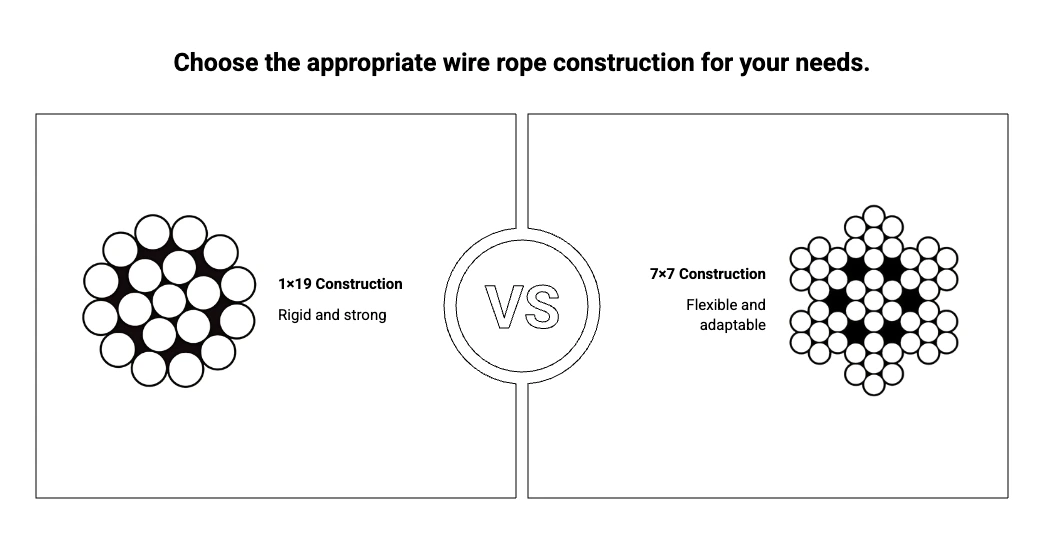
1×19 construction
1×19 is a single bundle of 19 thick wires laid up together. It is the stiffest of the three and stretches the least, which is why it holds tension well on long straight runs and needs little re-tensioning over its life. The Australian Building Codes Board (ABCB) confirms this in plain terms, noting that 1×19 wire has the greatest elastic modulus and takes up load with the least extension. The trade-off is that the thick wires make it rigid. You cannot loop it neatly around a thimble, so it terminates with hydraulic or factory swaging rather than hand tools.
7×7 construction
7×7 is seven strands of seven wires, 49 in total. The smaller wires slide against each other when bent, so the rope is semi-flexible. It loops around thimbles, takes hand-swaged ferrules, and handles bends and stair transitions that 1×19 fights. It stretches a little more than 1×19, so it can need a touch more attention to tension, but the easier handling makes it a common choice where a run changes direction.
7×19 construction
7×19 is seven strands of 19 wires, the most flexible of the three. That flexibility makes it the usual pick for marine rigging and dynamic jobs rather than straight balustrade infill. It does have a defined place in balustrading: for continuous vertical or near-vertical wire that has to turn around pulley blocks, the code calls up 7×7 or 7×19, because the stiffer constructions cannot make the turns.
For the stainless options across these constructions, see our stainless steel wire rope range.
Choosing between 1×19 and 7×7: a job that went sideways
A deck builder rang us partway through a multi-level veranda. His horizontal wire kept sagging and dropping tension around the corner posts and the stair transitions, and he could not work out why. He had ordered a standard spool of 1×19, on the reasonable assumption that wire is wire as long as it is stainless.
We talked through his layout over the phone. The problem was the construction, not the tension. 1×19 is built for straight, uninterrupted runs between two end posts. The moment he tried to take it through intermediate posts and around stair angles, the rigid wire bound and shed tension. We moved him to 3.2mm 7×7. Because it flexes, it snaked through the intermediate posts and took the stair changes cleanly while holding tension. The lesson he took away is the one worth keeping: pick the construction for the run. Straight lines suit 1×19. Corners and stairs suit 7×7 or 7×19.
Does the stainless steel grade matter? Grade 316 vs 304
Yes, and it is one of the bigger calls on the job. Grade 316 carries roughly 2% molybdenum that grade 304 does not, and that molybdenum is what resists the chloride attack you get near salt air. The Australian Stainless Steel Development Association (ASSDA) advises that grade 316, or an equivalent, should be the minimum within five kilometres of the surf, with higher grades such as 2205 duplex for splash zones and unwashed areas.
This is where “stainless” gets misread as “stain-proof”. A fabricator once called to order a large run of grade 304 wire and fittings for a balcony job on a block of coastal townhouses, trimming material cost to win the tender. We checked the location. In that salt-air environment, 304 would tea stain and pit within months, and the rectification claim would land back on him. We walked through the metallurgy and moved the order to 316. The small lift in material cost was cheap next to a callback on a finished coastal balcony. ASSDA makes the same point for marine work, noting that grade 316 covers around 90% of marine applications where 304 would pit. Stainless is corrosion-resistant for the right environment, not immune to rust in the wrong one. If your job is near the coast, talk the grade through with our team before you order.
How far apart should balustrade wires be?
Openings in the barrier must be small enough that a 125mm sphere cannot pass through, which is why most wire balustrades run their wires around 80mm apart. The ABCB tests this with a 125mm cone pushed against a pair of wires at mid-span under a set force, so resting spacing has to be tight enough that the wires do not spread past the limit under load.
How many runs that works out to depends on the barrier height and the spacing. A 1-metre-high balustrade with wires at 80mm commonly lands around 11 runs, though that is a widely used industry setup rather than a fixed code figure. The National Construction Code (NCC) sets the targets, not the wire count: its barrier tables specify the tension and deflection your wire, spacing and post span have to meet, so the number of wires follows from the geometry of your job. Wider post spacing pushes the required tension up fast, which is why a tighter post span is often the practical way to hit the numbers.
Pools are a separate and stricter case, so the 125mm figure does not carry across. Where a wire balustrade forms part of a swimming pool safety barrier, it falls under Australian Standard AS 1926.1 instead of the general barrier rules, and the gap limit tightens to 100mm. AS 1926.1 also sets a non-climbable zone, which means horizontal wires, an easy foothold for a small child, are often not suitable as the pool barrier itself. If your job is poolside, confirm the design with a pool safety inspector before you order, and our pool fencing range covers compliant components.
When do you need vertical wires instead of horizontal?
When the possible fall is more than 4 metres, horizontal wires are out and the barrier has to use vertical wires (and the same applies around pools). The reason is climbability. The Queensland Government’s deck and balcony safety guideline sets out the rule that applies nationally under the NCC: where a fall is more than 4 metres, the barrier must have no climbable elements between 150mm and 760mm above the floor. Horizontal wires in that band read as a ladder for a small child, so they are not allowed.
This catches people at the quoting stage. A developer rings to order a standard horizontal kit for a balcony, the finished floor sits 4.2 metres above the ground, and the whole approach has to change to a vertical system. Vertical wire can run around pulley blocks and uses the more flexible 7×7 or 7×19 construction. If your fall height is anywhere near the 4-metre mark, confirm it before you order, because it decides the entire setup.
What makes a wire rope balustrade compliant?
Compliance comes from measured tension, not from tightening the wire until it looks right. Under the NCC, a wire barrier has to either meet the tension values in the relevant table, measured with a strain indicator, or pass the maximum deflection check. The residential rules sit in the ABCB Housing Provisions Part 11.3, and the equivalent provisions for commercial Class 2 to 9 buildings sit in Part D3 (clauses D3D17 to D3D21). On top of the infill rules, the posts, rails, fittings and fixings have to carry the barrier loads in AS/NZS 1170.1, with higher loads for public and crowd areas than for a house.
Two practical notes. First, the current edition is NCC 2022 Amendment 2, in force from 29 July 2025, and NCC 2025 is in preview with jurisdictions able to adopt from 1 May 2026, so confirm which version your state is enforcing on a current job. Second, Keble’s supplies the wire, the fittings and practical guidance, and we hold mill certificates on our wire rope, but we do not provide engineering certification or compliance sign-off. Final compliance is verified by your certifier or engineer against your specific build. You can match the wire and the stainless fittings to the job with us, then have the install signed off on site.
Common wire rope balustrade mistakes to avoid

Most of the failures we see on wire balustrades trace back to five things, and none of them are the wire itself.
- Under-tensioning. Wire that looks tight by hand often is not tight enough to hold the spacing under load. Tension to the code values and check it.
- Posts spaced too far apart. Open up the post span to keep the view and the required tension climbs past what the posts can take. A builder once set timber intermediate posts at 1.8 metres to keep a balcony view open, and the wire would have spread past the gap limit on inspection. Bringing the clear span back to a tighter spacing fixed it.
- Wrong grade for the site. Grade 304 on a coastal job will tea stain. Match the grade to the environment.
- Bending wire around corners. Running a single wire continuously around a corner post makes even tension almost impossible and fatigues the wire. Terminate and tension each run at the change of direction.
- End-post bowing. Eleven runs of tensioned wire put well over a tonne of cumulative pull on the end posts. A carpenter rang us once because every time he tensioned the last run, the first three went slack. The fix is structural: a properly fixed top rail that acts as a strut to hold the posts apart, so the tension stays put.
These are the same patterns ASSDA and the code warn about, and they are why the build matters as much as the parts. Our installation tips post covers the setup side in more detail.
Wire rope balustrade FAQs
How long does a wire balustrade last? A well-specified stainless wire balustrade can last for decades, but service life depends on grade, environment and upkeep, not just the wire. The code itself notes that wire barriers lose tension over their life, so periodic checks and re-tensioning keep a barrier compliant and safe.
Do cable railings eventually sag? Wire can lose tension over time, especially where fittings bear against soft timber posts or where temperature swings are large. This is normal, and it is why the code allows for re-tensioning and, in some cases, lock-off devices. A sound install with the right top rail and fittings holds far better.
Are wire balustrades legal in Australia? Yes, when they meet the National Construction Code. That means the right height, openings a 125mm sphere cannot pass, compliant tension or deflection, and a non-climbable design where the fall is more than 4 metres. Your certifier confirms the finished barrier.
Do wire balustrade rules change around a pool? Yes. Where a wire balustrade forms part of a pool safety barrier, it falls under Australian Standard AS 1926.1, not the general NCC barrier rules. That standard tightens the gap limit to 100mm and sets a non-climbable zone, so horizontal wires often will not pass as the pool barrier itself. A licensed pool safety inspector confirms a poolside barrier.
What wire size should I use? Most balustrade wire is 3.2mm, with 4mm used for a heavier look or longer spans. The construction (1×19, 7×7 or 7×19) usually matters more than diameter alone, because it decides stiffness, termination and how the wire handles bends.
Do wire purchases include fittings and swaging? Not automatically. Fittings, swaging and finished assemblies are generally quoted separately from the wire itself, so tell us the full scope and we will quote the complete setup rather than the rope alone.
How much does a wire rope balustrade cost? Pricing varies depending on specification: the construction, the grade, the diameter, the cut lengths, the fittings and the scale of the job. We offer trade pricing, and the quickest path is to send us the details for a quote rather than work off a rough rate per metre.
Getting the right wire rope balustrade setup
The wire is the easy part. The result comes from matching the construction to the run, the grade to the environment, and the spacing and tension to the code, then building posts and rails that hold it all. Get those right and a wire balustrade gives you a clean, open barrier that passes inspection and stays sound.
That is where talking to people who handle this every day saves time. Keble’s Trading has supplied wire rope and balustrade hardware to the trade for more than 36 years, with experienced trade-focused staff, custom cut lengths, in-house hydraulic and roll swaging, and mill certificates on our wire rope. We work from four Melbourne locations: Dandenong, Campbellfield, Laverton and Kilsyth.
If you have a job coming up, send us your post spacing, fall height and the environment, and we will help you match the wire, the grade and the fittings before you order. Call the team or send an enquiry through our contact form.
About the author
Brett Penn is a writer working with the Keble’s Trading Technical Team, focusing on stainless steel handrails, wire rope systems, rigging hardware and industrial product applications. The Keble’s Trading team works closely with builders, stainless fabricators, installers and industrial customers across residential, commercial and infrastructure projects throughout Australia.
Editorial note: This article may be updated periodically to reflect changes to Australian Standards, NCC guidance and industry best practices.
Important note: This article provides general information only and does not replace engineering advice, building approvals, installation review or project-specific compliance assessment. Content provided in this blog article is for general information only and not advice or a substitute for building standards or codes in Australia.
Also note for clarification:
ABCB stands for the Australian Building Codes Board. It’s the joint body set up by the Australian Government together with the state and territory governments (with local government also represented) that develops and maintains the National Construction Code (NCC), the set of rules the blog refers to for barrier height, opening sizes, wire tension and the like. In practice, when the post cites the ABCB, it’s pointing to the NCC and its supporting Housing Provisions, which the ABCB publishes.





& OPERATED

EXPERIENCE

PRICES

& SUPPORT
- Monday to Friday - 8:00AM - 4:30PM
- Saturday - Closed
- Sundays & AU/VIC Public Holidays - Closed
No Comments yet!