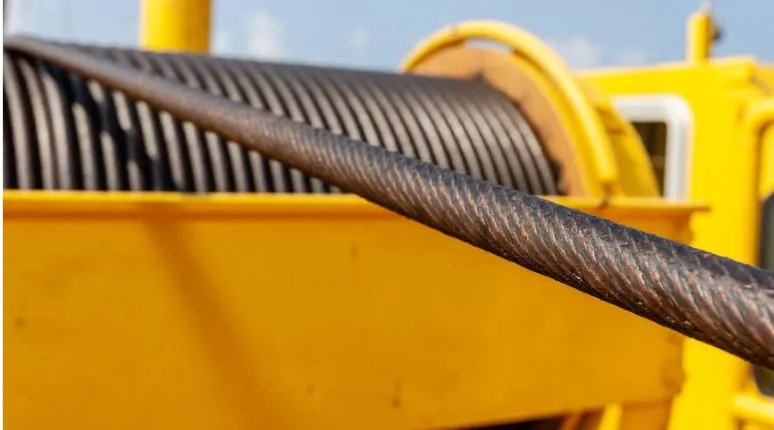
Wire Rope Uses for Lifting, Rigging & Balustrade
Written by: Brett Penn, Keble’s Trading Team
Reviewed by: Keble’s Trading Technical Team
Updated: 17 June 2026
TL;DR
- Wire rope is used across construction, lifting, balustrade, marine, mining, catenary, load restraint and agricultural applications. Each has different construction and grade requirements.
- The two most common material choices are galvanised and stainless steel (grade 304 or 316). Environment determines which is appropriate.
- Construction type (1×19, 7×7, 7×19, 6×36) controls flexibility and fatigue life. The wrong construction leads to premature failure even when diameter and grade are correct.
- Breaking strain is not safe working load. Understanding the difference matters before specifying wire rope for any load-bearing use.
- Not all wire rope is suitable for lifting. Only appropriately rated, tagged and certified rope and assemblies should be used in lifting applications.
Contents
- What is wire rope?
- Wire rope vs cable: what is the difference?
- Australian standards that apply to wire rope
- Wire rope constructions explained
- Quick-reference table: match your application to the right rope
- Wire rope grades and materials
- Wire rope uses across industries
- Wire rope inspection: what to check and when
- Common mistakes when selecting wire rope
- Selecting the right wire rope: a practical checklist
- Frequently asked questions
- Applications we see regularly: six common scenarios
- Talk to Keble’s Trading
The balustrade wire that starts tea-staining after 18 months. The lifting assembly that fails early because the construction was wrong for the sheave configuration. The coastal project that specified 304 stainless when the environment called for 316.
Three things determine whether wire rope does its job: the right material for the environment, the right construction for how the rope moves, and the right assembly for the load it carries. This guide covers all three, with a focus on applications common in Australian construction, industrial and trade work. If you want to browse the full range while reading, our wire rope category covers galvanised, stainless and coated options across all common constructions.
What is wire rope?
Wire rope is built from individual wires twisted into strands, with those strands laid around a core. Construction (the arrangement of wires, strands and core) controls the rope’s flexibility, crush resistance, fatigue life and suitability for different applications.
The main variables are:
- Material: galvanised steel or stainless steel (grade 304 or 316)
- Construction: the number of strands and wires per strand, such as 1×19, 7×7, 7×19, 6×19 or 6×36
- Core type: fibre core (FC) or independent wire rope core (IWRC)
- Diameter: measured in millimetres in Australia
- Finish: bare wire, galvanised, stainless or PVC/nylon coated
Two ropes of the same diameter and material can have very different service lives in the same application if their constructions differ. That is one of the most consistent sources of early failure we see from customers who have sourced wire rope without specifying construction.
Wire rope vs cable: what is the difference?
Wire rope and cable are not the same product, though the terms are used interchangeably in Australian trade.
Wire rope is a structural, load-bearing product built from multiple steel wires twisted into strands around a core. It carries mechanical loads: lifting, tensioning, mooring, bracing.
Electrical and communications cable carries current or signal. The internal wires run for conductivity, not tensile strength or flexibility under cyclic load.
In Australian trade, “wire rope,” “steel cable,” and “wire cable” often describe the same product — and terms like “balustrade cable,” “guy cable,” or “cable stays” all refer to wire rope assemblies — but electrical cable should never be substituted for structural wire rope in load-bearing or tensioning applications.
Australian standards that apply to wire rope
Two Australian Standards govern wire rope product specification and field use. Trade and procurement teams who need compliance documentation should know both.
AS 3569 covers the product specification for steel wire ropes, including minimum requirements for manufacture, testing, and designation. The current edition is AS 3569:2026, which updated the terminology and classification system to align with current international standards. This is the standard referenced when specifying wire rope for lifting equipment, cranes and hoists.
AS 2759 covers use, operation and maintenance of steel wire ropes. It specifies procedures for selection, storage, handling, inspection and discard. The NSW Government’s dogging and rigging guide requires inspections to be conducted in accordance with AS 2759 and the manufacturer’s recommendations.
For trade and procurement buyers: mill certificates are available on our wire rope products and should be requested for any application requiring documented traceability.
Wire rope constructions explained
What does the construction number mean?
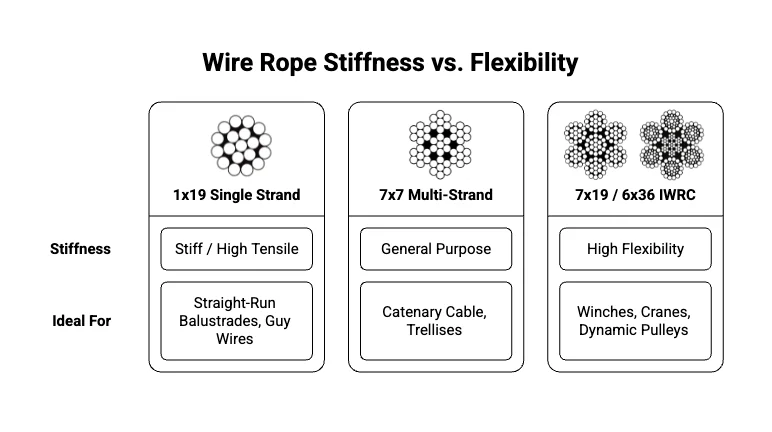
The construction number describes how a wire rope is built. The first number indicates the number of strands and the second indicates the number of wires in each strand. A 7×19 rope has 7 strands of 19 wires each. A 1×19 rope is a single strand of 19 wires.
More wires per strand means greater flexibility but less abrasion resistance. Fewer, thicker wires per strand means greater resistance to surface wear but reduced flexibility. The right construction depends on whether the rope stays static, bends around posts, or runs continuously over pulleys.
1×19: stiff, strong, minimal stretch
1×19 is the stiffest and most stretch-resistant of the common constructions, with the highest strength-to-diameter ratio. The single-strand structure does not flex well, so it suits straight-run applications where movement is not required.
Common applications: balustrade wire infill (horizontal straight runs), guy wires, standing rigging on vessels, architectural tension members, long-span cable systems.
7×7: general purpose flexibility
7×7 offers a balance between flexibility and strength. Construction crews regularly use this construction for maneuvering and towing, and it suits control cables, lashing, trellis wire, light rigging and balustrade applications where wires need to turn around posts.
Common applications: general rigging, catenary cable, security cable, trellis wire, agricultural applications, PVC-coated barrier wire.
7×19: high flexibility for dynamic applications
7×19 is the most flexible of the common stainless constructions. It handles repeated bending over sheaves and pulleys without the fatigue failure that stiffer constructions would suffer. Where a rope bends repeatedly during normal operation, 7×19 is usually the right choice.
Common applications: winch cables, hoisting configurations with sheaves, security cables, applications with repeated bending or pulley contact.
6×19 and 6×36: industrial and crane applications
Heavier crane, hoist and mining applications use multi-strand constructions such as 6×19 and 6×36 with independent wire rope cores (IWRC). The IWRC resists crushing under heavy loads and maintains rope diameter under tension. Rated lifting assemblies are built to these constructions as standard.
A practical decision point
Before selecting construction, answer one question: does the rope bend or flex repeatedly during normal operation? If yes, 7×19 is the starting point. If the rope stays static or runs in a straight line under constant tension, 1×19 or 7×7 suit depending on diameter and flexibility requirements. If the application involves heavy crane or hoist sheaves under substantial load, move to 6×19 or 6×36 IWRC.
For detailed diameter and breaking strain data across all constructions we stock, download the wire rope catalogue. It covers galvanised, stainless and coated ropes with specifications by construction and diameter.
Quick-reference table: match your application to the right rope
The table below maps the most common Australian wire rope applications directly to the recommended type, grade, construction and coating. Use it as a starting point, then contact us to confirm the specification for your exact job.
| Application | Recommended type | Grade | Construction | Coating |
|---|---|---|---|---|
| Wire balustrade, horizontal straight runs | Stainless steel | 316 (coastal/outdoor), 304 (indoor only) | 1×19 | None |
| Wire balustrade, posts with bends | Stainless steel | 316 (coastal/outdoor), 304 (indoor only) | 7×7 | None |
| Crane and hoist rope | Galvanised steel | High tensile (G1570+) | 6×19 FC or 6×36 IWRC | None |
| Marine mooring and standing rigging | Stainless steel | 316 | 1×19 (standing), 7×19 (running) | None |
| Guy wire (utility poles, towers, antennas) | Galvanised guy strand | High tensile | 1×7 or 1×19 | None |
| Catenary (overhead cable support) | Galvanised or PVC-coated galvanised | Standard | 7×7 | PVC where required |
| Mining hoist and shaft rope | Galvanised high-tensile | Specialist grade | 6×36 IWRC or rotation-resistant | None |
| Outdoor trellis, vineyard, agricultural | Galvanised | Standard | 7×7 | None |
| Playground, park barriers, public contact | Galvanised or stainless | 316 for outdoor | 7×7 | PVC coated |
| General rigging and load securing | Galvanised | G1570 minimum | 6×19 FC | None |
| Corrosive or chemical environments | Stainless steel or PVC-coated stainless | 316 | 7×7 or 7×19 | PVC over stainless core |
| Architectural cable features, shade structures | Stainless steel | 316 | 1×19 or 7×7 | None |
For custom sizing, certified assemblies or applications not listed here, contact our team. We run in-house load testing and certification on our 100-tonne test bed, which means we can certify assemblies to the required working load limit rather than relying on manufacturer data alone.
Not sure which rope suits your job? Our team has been specifying wire rope for Australian trade, construction and industrial customers since 1986. Call us on 1800 067 687 or send us an enquiry with your application details. We will tell you exactly what you need before you order.
Wire rope grades and materials
Galvanised wire rope
Galvanised wire rope has a zinc coating applied over the base steel wire. The zinc provides corrosion resistance through a physical barrier and sacrificial protection. It is the standard choice for construction, agricultural, load restraint, industrial and general-purpose applications where cost, strength and moderate corrosion resistance are the priorities.
Galvanised rope is stronger per diameter than stainless steel wire rope of the same construction and comes in larger diameters and higher grades for heavy crane and mining applications. Our galvanised wire rope range includes guy strand wire and general-purpose rope across a range of constructions and diameters.
Avoid it in sustained saltwater immersion or aggressive chemical environments. Once the zinc coating is compromised, the underlying steel corrodes.
Stainless steel grade 304
Grade 304 is the standard architectural and general stainless grade. It performs well in dry and mildly wet environments and is used for indoor balustrade applications, architectural features and general-purpose stainless rigging where corrosion exposure is limited.
Grade 304 is susceptible to pitting and crevice corrosion in coastal environments and chloride-rich conditions. In practice, 304 stainless on an exposed coastal balustrade can show tea staining and surface corrosion within months. That is not a product fault. It is the wrong grade for the environment.
Stainless steel grade 316
Grade 316 contains molybdenum, which resists chloride attack that pits and corrodes 304 in saltwater and coastal air. It is the right choice for marine, coastal, pool, food processing and chemical exposure applications.
87% of Australia’s population lives within 50 kilometres of the coast, according to the Australian Government’s 2021 State of the Environment Report. Grade 316 is the correct specification for most outdoor Australian wire rope balustrade and handrail projects, not just marine applications. The grade costs marginally more than 304. In salt air, it lasts considerably longer.
Grade 316 gives up a small amount of tensile strength per diameter compared to 304, but that trade-off is irrelevant in most balustrade and architectural applications where corrosion resistance is the governing factor.
We have seen this play out directly. A coastal balustrade customer originally specified 304 stainless and, after discussing the environment and the likely tea staining within months, upgraded to 316. The long-term performance difference was significant. The additional cost at purchase was not.
We stock stainless steel wire rope in both grade 304 and 316 across common constructions. For balustrade applications specifically, our post on types of balustrade wire ropes covers the 1×19, 7×7 and 7×19 options in more detail.
Wire rope uses across industries
Construction
Construction sites use wire rope across cranes, hoists, window-cleaning equipment, bracing cables, anchor ties, safety lines and fall-arrest systems. Each application has specific construction and certification requirements.
Crane and hoist ropes run over pulleys under load. Fatigue resistance is the priority, not raw strength. Structural bracing and anchor lines need high strength and minimal stretch. Fall-arrest and safety systems run to a different standard entirely: rated assemblies with documented testing and certification, not general rigging hardware.
For construction hoisting and crane applications, only correctly rated and certified wire rope assemblies with appropriate fittings should be used. Commercial rigging hardware is not automatically suitable for lifting without correct rating and tagging.
Lifting
The lifting industry uses wire rope in crane ropes, hoist cables, sling assemblies and rigging configurations across warehouses, ports, manufacturing facilities, infrastructure projects and construction sites. Wire rope for lifting must be selected based on the required working load limit (WLL), the rigging configuration, whether it runs over sheaves, the environmental conditions and the appropriate safety factor for the application.
Breaking strain is the load at which new rope fails under controlled testing conditions. The working load limit is the maximum safe load for everyday use, derived by applying an appropriate safety factor to the breaking load. These are not interchangeable. Using breaking strain as the working limit, without applying a safety factor for the application type, is one of the more serious errors we encounter in the field.
Wire rope slings must be constructed from suitable rope, correctly terminated and assembled, and tagged with their rated capacity. We provide load testing and certification services for lifting assemblies where required, along with a range of lifting equipment including chain slings, hoists and lifting clamps.
One situation we have resolved more than once: a customer attempted to replace worn hooks on a lifting assembly using non-rated hardware and expected simple re-tagging. The assembly was non-compliant. We sourced correctly rated components, re-tested the full assembly and provided compliant certification documentation. Replacing one component on a certified assembly does not preserve the original certification. The full assembly generally needs re-testing and re-tagging.
Balustrade and architectural
Stainless steel wire rope balustrade is one of the most common architectural applications in Australia, used for stair balustrades, deck edges, balcony barriers and pool fencing surrounds. Wire rope is also used in shade structures, green wall cable trellis systems and tensioned architectural cable features.
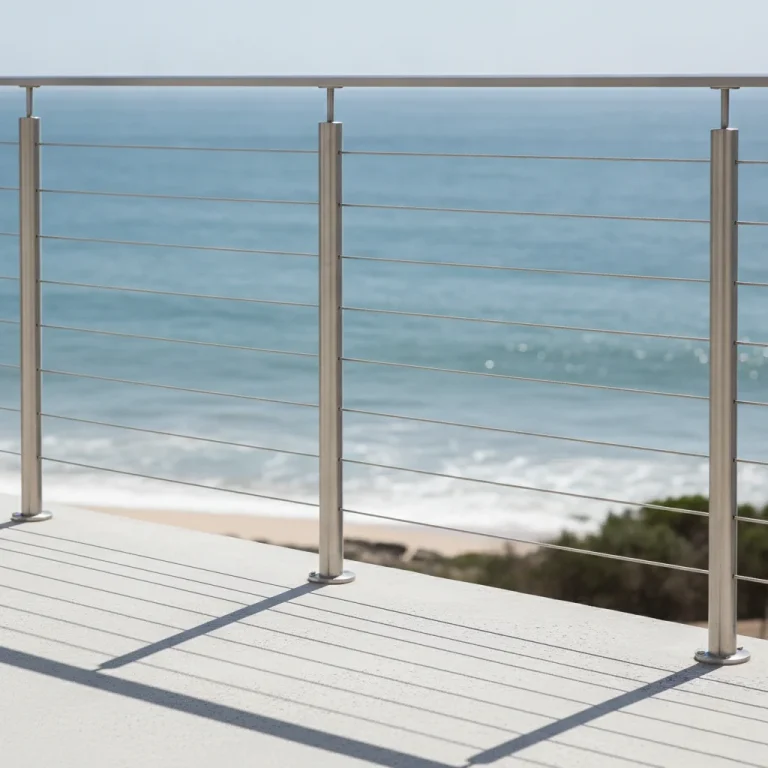
The standard balustrade wire in Australia is 3.2mm diameter in either 1×19 or 7×7. 1×19 is stiffer and better suited to longer straight runs. 7×7 has slightly more flexibility and is used where wires need to turn around posts.
Grade 316 stainless is the appropriate specification for most outdoor Australian installations. Grade 304 can be considered for sheltered indoor applications.
Keble’s supplies wire rope balustrade components including ropes, turnbuckles, swage studs, bottlescrews, terminals and tensioners. We do not provide engineering certification or compliance sign-off for balustrade designs. Customers remain responsible for engaging a qualified engineer where required for structural or pool fencing compliance.
Marine
Marine wire rope applications include standing rigging on vessels, mooring cables, anchor lines, crane cables on work vessels, fishing trawl wires and safety rails.
Marine environments are hard on wire rope. Saltwater, cyclic loading, UV exposure and contact with dissimilar metals all accelerate corrosion and fatigue. Grade 316 stainless is the right material choice for most marine applications. Running rigging that passes repeatedly over sheaves wants 7×19 construction for the flexibility and fatigue life.
Galvanised rope in marine environments requires consistent inspection and maintenance. The galvanising deteriorates under sustained saltwater exposure, and the underlying steel corrodes once the zinc is compromised.
Mining
Wire rope was first developed for mining applications and remains critical in deep-shaft hoist systems, ore extraction, equipment installation and underground supply lines.
Mining hoists run under sustained high loads, over large sheaves, through vibration and abrasion, for thousands of cycles before replacement. They need multi-strand constructions with IWRC cores to handle load, crush and fatigue simultaneously. These are specialist ropes with specific certification requirements, not general-purpose rigging rope.
Infrastructure, utilities and catenary
Galvanised wire rope is used extensively in infrastructure applications including guy wires for utility poles, towers and antennas, catenary cable for suspended electrical and communications cable runs, and structural bracing for bridges, masts and retaining systems.
Guy wires support structures under lateral load. They require high tensile strength with minimal elongation under sustained tension. 1×19 or 7×7 galvanised constructions are common depending on the diameter required. We stock galvanised guy wire in standard constructions for utility, tower and antenna applications.
Catenary wire supports overhead cable runs in commercial buildings, warehouses, event venues and outdoor installations. PVC-coated galvanised wire rope suits catenary runs where the coating adds surface protection and a clean finished appearance.
Load restraint and transport
Rated chain and wire rope systems are used in road transport load restraint for securing freight, equipment and machinery to vehicle decks. Load restraint equipment must comply with the Load Restraint Guide published by the National Transport Commission. Non-rated or incorrectly configured restraint systems are both a compliance issue and a safety risk.
We supply load restraint equipment including rated chain, load binders, tie-downs and winches.
Agricultural and general purpose
Galvanised wire rope is widely used in agricultural fencing, trellis wire systems, vineyard support cables, irrigation systems and general-purpose tensioning applications. 7×7 galvanised in smaller diameters is common for trellis and vineyard cable due to flexibility and ease of termination. PVC or nylon coated wire rope is used where the coating protects the underlying cable from surface damage or provides colour coding for identification.
Wire rope inspection: what to check and when
Wire rope does not have a fixed service life. It retires on condition, not on age alone. The relevant reference in Australia is AS 2759, which specifies inspection frequency and discard criteria for wire rope in service.
For lifting applications, the NSW Government’s dogging and rigging guide requires inspections in accordance with AS 2759 and the manufacturer’s recommendations, at intervals appropriate to the duty cycle.
Before each lift, check for:
- Broken wires on the outer surface of strands. Broken wires on the crown of strands are normal fatigue deterioration. Broken wires in the valleys between strands are more serious and may indicate internal fatigue.
- Diameter reduction. Measure the rope and compare to its original diameter. A significant reduction can indicate internal wear or core damage.
- Corrosion. Surface rust discolouration is an early indicator. Pitting or corrosion that loosens outer wires is a more serious condition.
- Deformation. Kinking, birdcaging, core protrusion or crushing all indicate the rope has been damaged and should be removed from service.
- Condition at terminations. Broken wires, corrosion or damage close to swaged fittings or wire rope grips are critical failure points and the ones inspectors most often miss.
A mill certificate should be available for the rope. It provides the diameter, construction, grade of steel and working load limit, which are all relevant reference points for inspection.
For a detailed guide to inspection triggers and removal criteria, see our post on when to remove wire ropes from service. We provide in-house inspection, testing and certification services for lifting assemblies. If equipment condition is unclear, a formal inspection and load test is a more reliable outcome than a visual-only check.
Common mistakes when selecting wire rope
Treating all wire rope as interchangeable. Diameter is not the only specification that matters. Construction, grade and core type all affect how the rope performs. Selecting on diameter alone without specifying construction leads to premature failure in applications with bending, sheave contact or high load cycles.
Assuming stainless means rust-proof. Stainless steel resists corrosion. It does not prevent it in all environments. Grade 304 in a coastal or pool environment will show tea staining and pitting. Grade 316 holds up far better in those conditions because the molybdenum content resists chloride attack. Neither grade is maintenance-free, and regular cleaning matters for long-term appearance and performance.
Confusing breaking strain with safe working load. Breaking strain is the load at which new rope fails under idealised test conditions. The working load limit applies appropriate safety factors for real-world use, including dynamic loading, rigging angles and the effects of deterioration over time. Specifying wire rope for lifting based on breaking strain without applying a safety factor has caused failures.
Using commercial hardware for lifting. Shackles, rings and fittings sold for general rigging and architectural use are not automatically rated for lifting. Only fittings that are specifically rated, marked and certified for lifting should be used in lifting applications.
Replacing one component on a certified assembly without retesting. Replacing a hook, shackle or rope section on a tagged lifting assembly does not preserve the original certification. The full assembly generally needs to be re-tested and re-tagged. This is a common misunderstanding, particularly when a single component shows wear and the rest of the assembly appears serviceable.
Selecting the wrong grade for the environment on price. A customer who upgrades from 304 to 316 stainless at specification pays a modest premium. A customer who reverts to 304 to reduce cost and then deals with tea staining, surface corrosion and early replacement pays more overall. For a coastal balustrade project, 316 is the correct specification the first time.
All of them are avoidable. Discuss the application before placing the order. Call us if there is any uncertainty about what the job needs.
Selecting the right wire rope: a practical checklist
Before specifying wire rope for any application, work through these questions:
- Is the rope lifting, tensioning, restraining, running over pulleys, or sitting static under constant tension?
- What environment will it operate in? Indoor, sheltered, outdoor, coastal, marine, pool area, agricultural, chemical?
- What loads does it need to carry, including dynamic, shock or impact loads?
- Does the application require a rated and certified assembly with tagging and documentation?
- How is the rope terminated? Swaged fittings, wire rope grips or mechanical splices each have specific requirements.
- Is traceability required? Mill certificates are available on our wire rope and should be requested for commercial and industrial applications.
For guidance on specific applications, contact our team at any of our four Melbourne locations. Our wire rope guide covers selection in more detail, our galvanised vs stainless guide works through the grade comparison for common Australian applications, and our wire rope catalogue has diameter, construction and breaking strain data for the full range we stock.
Frequently asked questions
What is wire rope used for?
Wire rope is used in any application requiring a strong, flexible tension member that resists fatigue, abrasion and environmental exposure. Common uses include crane and hoist lifting, wire balustrade infill, marine rigging and mooring, mining shaft hoisting, guy wires for towers and utility poles, catenary cable support, load restraint in transport, and architectural cable features. The right wire rope for each use depends on the load, the environment and whether the rope runs over pulleys or stays static.
What is the difference between wire rope and cable?
Wire rope is a structural product built from multiple steel wires twisted into strands around a core, engineered to carry mechanical loads. Electrical cable carries current or signal and is not designed for structural use. In Australian trade, “steel cable,” “wire cable” and “wire rope” are often used to describe the same product. In any load-bearing, tensioning or rigging application, wire rope is the correct product. Electrical cable should never be substituted.
What type of wire rope is used in construction?
Construction applications use different wire rope types depending on the job. Crane and hoist ropes are typically galvanised high-tensile rope in 6×19 or 6×36 IWRC construction, rated and certified for the crane’s capacity. Structural bracing and anchor cables use high-strength constructions with minimal stretch such as 1×19. Fall-arrest and safety lines require rated and certified assemblies. Stainless steel 316 is used where the rope is exposed to weather or coastal conditions.
What is galvanised wire rope used for?
Galvanised wire rope is used in construction, mining, agricultural, load restraint, infrastructure and general-purpose industrial applications where strength and moderate corrosion resistance matter more than appearance. Common applications include crane ropes, guy wires, catenary cable, agricultural fencing and trellis wire, load binders, and mining hoist cable. It is not suitable for sustained saltwater immersion or aggressive chemical exposure, where stainless steel 316 is the correct choice.
What is stainless steel wire rope used for?
Stainless steel wire rope is used in applications where corrosion resistance and appearance are priorities: wire balustrade, marine rigging, coastal and pool environments, architectural cable features, food processing facilities, and chemical exposure applications. Grade 316 is the correct specification for outdoor Australian installations, coastal environments and anything near saltwater or pool chlorine. Grade 304 suits sheltered indoor applications. Neither grade is maintenance-free in harsh environments.
What does 7×7 or 6×19 mean in wire rope specifications?
The two numbers describe how the rope is built. The first number is the number of strands. The second is the number of wires in each strand. A 7×7 rope has 7 strands of 7 wires each (49 wires total). A 6×19 rope has 6 strands of approximately 19 wires each. More wires per strand means more flexibility but less abrasion resistance. Fewer, thicker wires per strand means greater resistance to surface wear but reduced flexibility. A 1×19 rope is a single strand of 19 wires, giving it the highest stiffness and strength-to-diameter ratio of common constructions.
What is the best wire rope for outdoor use in Australia?
For most outdoor Australian applications, grade 316 stainless steel wire rope is the correct choice. Given that the majority of Australians live within a few kilometres of the coast, salt air exposure is a factor even when a project does not appear to be in a marine environment. Grade 316 contains molybdenum, which improves chloride resistance compared to grade 304 by resisting the pitting and crevice corrosion that attacks 304 in salt air. Galvanised wire rope suits inland outdoor applications where cost and strength are the priority and sustained saltwater exposure is not a factor.
What is the difference between breaking strain and safe working load?
Breaking strain is the load at which a new rope fails under controlled laboratory test conditions. Safe working load, now more correctly called working load limit (WLL), is the maximum load a rope should carry in actual use. The WLL is derived by dividing the breaking strain by an appropriate safety factor for the application. For lifting, safety factors are typically 5:1 or higher. Using breaking strain as the working load without applying a safety factor is a serious error that has caused equipment failures and injuries.
Can any wire rope be used for lifting?
No. Wire rope suitability for lifting depends on the construction, grade, certification and how the assembly is terminated and tagged. Only wire rope specifically rated, assembled and certified for lifting should be used in lifting applications. Architectural, balustrade and general-purpose wire rope are not automatically suitable for lifting even if they are physically strong enough. Commercial rigging hardware such as shackles and rings must also be specifically rated for lifting. Unrated hardware should never be substituted in a lifting assembly.
What is the difference between a fibre core and an IWRC?
A fibre core (FC) sits at the centre of the rope and provides a cushion that increases flexibility. It is used in applications where the rope needs to bend easily, such as general rigging and some hoist applications. An independent wire rope core (IWRC) replaces the fibre centre with a small wire rope. IWRC provides superior crush resistance when the rope wraps around drums under heavy load and maintains the rope’s diameter better under tension. IWRC is the standard specification for crane ropes, mining hoists and any heavy lifting application involving drums and sheaves under significant load.
How long does wire rope last?
Wire rope does not have a fixed service life measured in years. Retirement is determined by condition, not age. Factors that affect service life include the application load and cycle frequency, how the rope runs over sheaves or drums, the environment, how well it is maintained, and the quality of the original termination. A balustrade wire under static tension in a sheltered environment may last many years. A crane rope running over sheaves under heavy daily load may need replacement in months. The correct approach is regular inspection against the criteria in AS 2759 rather than time-based replacement.
What is PVC-coated wire rope used for?
PVC-coated wire rope is galvanised or stainless steel wire rope with a plastic outer coating extruded over the surface. The coating provides a smooth surface that protects against wire end protrusion, adds a layer of corrosion resistance, allows colour coding, and improves the appearance in visible applications. Common uses include playground and park equipment, barrier cables, catenary cable runs, garden trellis systems, vineyard support cables, and safety lines in public areas. The coating does not replace the need to select the correct underlying construction and grade for the application.
What is catenary wire?
Catenary wire is wire rope suspended between two fixed points and used to support overhead cable runs, lighting, festoon cables or other loads across a span. The wire rope acts as the structural spine, with the supported cable or equipment hanging from it. Galvanised wire rope in 7×7 construction is common for catenary applications. PVC-coated versions are used where the coating provides additional protection or a cleaner finish. The wire rope needs to be correctly tensioned and terminated at both ends, with appropriate fittings to resist the combined weight of the rope and the supported load.
What Australian standards apply to wire rope?
Two key Australian Standards govern wire rope in trade and industrial use. AS 3569 is the product specification standard covering minimum requirements for manufacture, testing, designation and classification of steel wire ropes, including those used with cranes and hoists. The current edition is AS 3569:2026. AS 2759 covers use, operation and maintenance, specifying procedures for selection, storage, handling, inspection and discard of wire ropes in service. These are the standards referenced by regulators, engineers and safety inspectors when assessing wire rope compliance in Australian workplaces.
How do I know when to replace wire rope?
Wire rope should be inspected regularly and removed from service when it shows specific deterioration. Key indicators include broken wires on the outer strands, diameter reduction from the original measurement, visible corrosion particularly at or near terminations, deformation such as kinking or birdcaging, and any damage from heat, crushing or impact. The inspection and discard criteria are set out in AS 2759. For lifting applications, the NSW Government’s dogging and rigging guidance requires inspections to be carried out in accordance with AS 2759 at intervals appropriate to the duty cycle. Our post on when to remove wire ropes from service covers the specific indicators in more detail.
What does WLL mean?
WLL stands for working load limit. It is the maximum load a wire rope or assembly should carry in service, accounting for an appropriate safety factor relative to the breaking strain. WLL replaces the older term safe working load (SWL), though both terms remain in use. For lifting applications, WLL must be marked on the assembly tag. Keble’s can certify lifting assemblies to a specified WLL using our in-house 100-tonne test bed, providing the documentation required for workplace compliance.
Do I need a mill certificate for wire rope?
For commercial, industrial and lifting applications, a mill certificate is strongly recommended and in some cases required. A mill certificate confirms the rope’s diameter, construction, grade of steel, tensile strength and minimum breaking load. It provides traceability back to the manufacturing batch, which is important for project handover documentation, quality audits, and any future inspection or compliance review. Mill certificates are available on all wire rope we supply. Request one at the time of order for any project where documentation will be required.
Applications we see regularly: six common scenarios
Construction site crane and hoisting rope
A builder contacts us needing replacement rope for a tower crane. The application involves lifting steel beams and formwork panels repeatedly throughout the day, with the rope running over multiple sheaves at the top of the mast.
The key specification decisions here are construction and core type. A rope running over sheaves under significant load needs a flexible, fatigue-resistant construction with an independent wire rope core (IWRC) to resist crushing as the rope wraps around the drum. Galvanised is standard for this type of site application. The rope also needs to be correctly rated for the crane’s capacity, and the assembly needs to be tagged and certified before use. We supply the rope and fittings and can assist with testing and certification where required.
The mistake we see in this application is sourcing rope purely on diameter and breaking strain without considering construction. A rope that is technically strong enough on paper but the wrong construction for the sheave configuration will fail early under cyclic fatigue.
Mining: deep shaft hoisting and infrastructure
Mining customers typically come to us with demanding specifications. Deep shaft hoist rope operates under high sustained loads, runs over large sheaves, endures vibration and abrasion, and cycles thousands of times before replacement.
These applications require multi-strand constructions with IWRC cores and specific grades to handle the load, crush and fatigue demands simultaneously. The rope also needs to be correctly certified for the application, and we can assist with documentation and testing requirements.
We also supply to surface infrastructure applications in mining environments, including structural bracing, guy wires for site equipment and general rigging. Not all wire rope supplied to a mining site is shaft-rated. It is worth clarifying the exact application before specifying.
Coastal architectural balustrade
This is one of the most consistent application discussions we have. A fabricator or builder is quoting a balustrade job on a residential or commercial coastal project and needs to specify wire rope infill. The grade question comes up every time. The environment determines the answer. Within a few kilometres of the coast, and particularly where salt air is carried by prevailing winds, grade 316 stainless is the correct specification. Grade 304 will perform adequately in sheltered inland applications but will show tea staining and surface corrosion in a coastal environment within months. That is not a product defect. It is a specification error.
The construction choice for horizontal straight runs is typically 3.2mm 1×19, which provides the stiffness required for a clean taut appearance under tension. Where wires need to pass around posts or take any bend at the termination, 7×7 is more appropriate.
We discuss the environment and intended installation before recommending grade and construction. A rework conversation after installation costs far more than a phone call before the order.
PVC-coated wire rope for public infrastructure
PVC-coated wire rope comes up in applications where the outer coating serves a specific function beyond corrosion protection. Common examples include playground equipment and climbing structures, park barrier cables, catenary cable runs in public spaces, and safety lines in areas with regular public contact.
In public infrastructure and playground applications, the PVC coating provides a smooth, splinter-free surface and seals moisture away from the underlying steel core. The colour options available also allow for visual identification of cable runs or compliance with design requirements.
The underlying wire rope construction needs to suit the application, not just the coating. A catenary run supporting cable weight in a straight span has different requirements from a barrier cable that sees lateral impact loading. We specify the core construction based on the application and apply the coating to suit the surface requirement. Browse our PVC-coated wire rope range for available options.
Theatre and entertainment rigging
Entertainment rigging involves wire rope in fly systems, grid drops, counterweight lines and load suspension above performance spaces. The requirements differ from industrial lifting in some important ways.
The rope construction needs to suit the sheave and drum dimensions used in theatre fly systems, which differ from standard industrial lifting equipment. Flexibility matters because the rope wraps tightly around drums and pulleys at various angles. The finish also matters in some applications, particularly where rope is visible to an audience or where a low-visibility matte finish is preferred for overhead drops.
We have supplied wire rope for entertainment rigging applications and can discuss construction and finish options to suit the specific rigging configuration. As with all applications involving suspension above people, the assembly needs to be correctly rated, tested and certified for the loads involved.
Corrosive industrial environments
Some industrial environments are hard on wire rope in ways that go beyond standard outdoor corrosion. Chemical processing plants, electroplating facilities, food and beverage production and facilities with acid wash or cleaning processes all create aggressive atmospheres that attack standard galvanised rope quickly.
In environments with chemical exposure, the selection of grade and finish needs to account for the specific chemicals present, not just general corrosion resistance. Grade 316 stainless holds up far better than galvanised in most chemical environments because the molybdenum resists the acid and chloride attack that strips galvanised coating quickly. PVC-coated wire rope with a stainless core adds a physical barrier against direct chemical contact, which suits overhead hoist and crane applications where the rope is exposed to splashing or fumes.
We recommend discussing the specific chemical environment before specifying rope for these applications. The wrong grade deteriorates fast, and in a lifting application that means safety consequences well beyond replacement cost.
Talk to Keble’s Trading about your wire rope requirement
Keble’s Trading has supplied wire rope, rigging hardware and lifting equipment to builders, fabricators, riggers and industrial customers across Melbourne and Australia since 1986. We stock galvanised wire rope, stainless steel wire rope and PVC-coated wire rope across a range of constructions and grades, with mill certificates available on all wire rope products.
Call or send an enquiry and we will:
- Advise the right grade, construction and diameter for your specific application and environment
- Test and certify lifting assemblies on our in-house 100-tonne test bed
- Cut wire rope to length to reduce onsite waste and preparation time
- Supply from four Melbourne warehouse locations with stock ready for trade customers across Victoria
- Ship wire rope nationally for commercial and industrial projects across Australia
Call us on 1800 067 687 to speak directly with our team. If you know your specification, we can quote it immediately. If you are not sure, tell us the application and we will work through the options with you.
Prefer to send through your requirements? Use our contact form and a member of our team will respond promptly.
Trade account customers can enquire about account facilities by contacting any of our four Melbourne branches directly.
About the author
Brett Penn is a writer working with the Keble’s Trading Technical Team, focusing on stainless steel handrails, wire rope systems, rigging hardware and industrial product applications. The Keble’s Trading team works closely with builders, stainless fabricators, installers and industrial customers across residential, commercial and infrastructure projects throughout Australia.
Editorial note: This article may be updated periodically to reflect changes to Australian Standards, NCC guidance and industry best practices.
Important note: This article provides general information only and does not replace engineering advice, building approvals, installation review or project-specific compliance assessment. Content provided in this blog article is for general information only and NOT advice or a substitute for building standards or industry codes in Australia.



& OPERATED

EXPERIENCE

PRICES

& SUPPORT
- Monday to Friday - 8:00AM - 4:30PM
- Saturday - Closed
- Sundays & AU/VIC Public Holidays - Closed
No Comments yet!