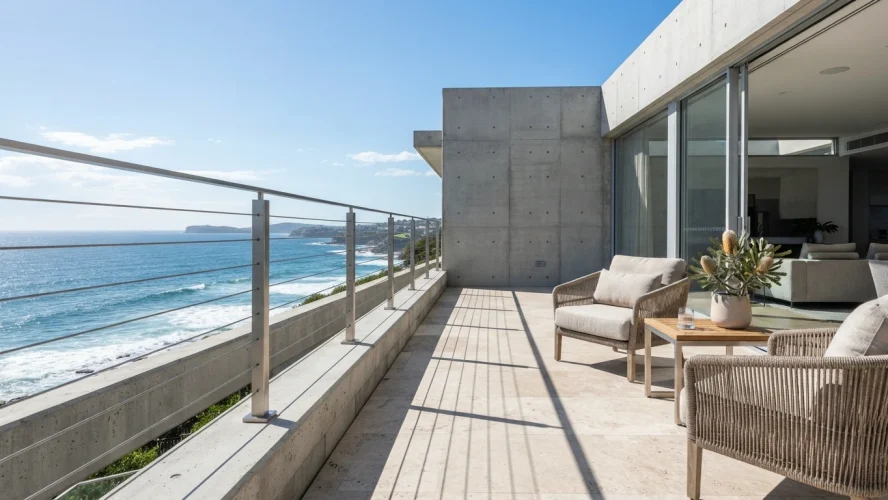
Galvanised vs stainless steel wire rope: A practical guide for Australian conditions
Written by: Brett Penn, Keble’s Trading Team
Reviewed by: Keble’s Trading Technical Team
Updated: 30 June 202
TL;DR
- Galvanised wire rope suits inland, industrial, and replaceable lifting applications where strength per diameter matters and the rope can be inspected and serviced on a schedule.
- Stainless wire rope (grade 316 minimum within 5km of the surf) suits coastal, architectural, and embedded permanent installations where corrosion resistance and appearance matter more than raw strength.
- Construction (1×19, 6×19, 6×36, 7×19) often matters more than the finish. The wrong construction is one of the most common reasons a rope fails early.
- Stainless steel is not “set and forget” in marine air. It still tea-stains, still needs washing near the coast, and can fail in less obvious ways if the wrong grade was specified.
- If you are not certain which rope is correct for your project, call us on 1800 225 521 or send through an enquiry. A short conversation saves a wrong order, a callback, or a failure in service.
- If you are not certain which rope is correct for your project, call us on 1800 225 521 or send through an enquiry. A short conversation saves a wrong order, a callback, or a failure in service.
Introduction
The choice between galvanised and stainless steel wire rope in Australia is rarely about which is “better.” Both are common, both are useful, and both fail when used in the wrong application. The right rope for your project depends on the environment it sits in, the load it carries, how often it bends, and whether you can inspect and replace it later.
We wrote this guide for builders, fabricators, riggers, installers, and trade buyers who want a clear answer without the marketing fluff. We have supplied wire rope across construction, industrial, marine, agricultural, architectural and infrastructure projects in Melbourne and across Australia since 1986. The patterns below come from that experience and from the Australian Standards and technical guidance that govern wire rope use in this country.
What is the difference between galvanised and stainless steel wire rope?
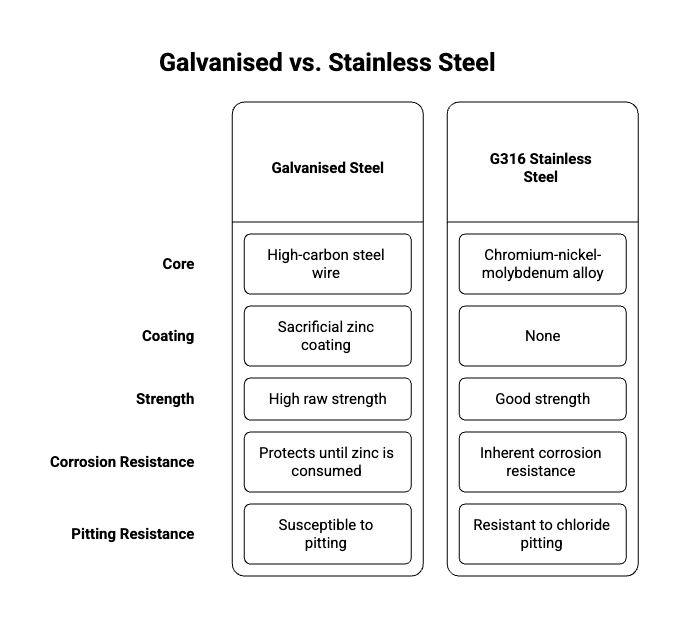
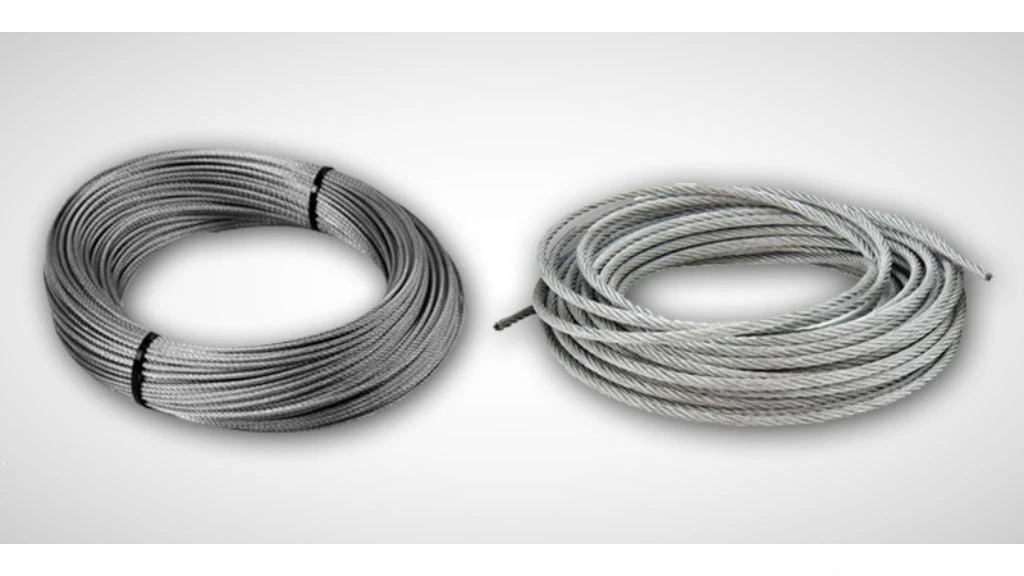
Galvanised wire rope is high-carbon steel wire coated in zinc. Stainless wire rope is a chromium-nickel alloy throughout the wire itself.
That single distinction drives everything that follows. Galvanised rope depends on a sacrificial outer coating to protect carbon steel underneath. When the zinc is consumed by atmospheric corrosion, abrasion, or mechanical damage, the steel inside starts to rust. Stainless wire rope carries its corrosion resistance inside the alloy. Per Atlas Steels grade data, 316 contains molybdenum at roughly 2 to 3% on top of its chromium and nickel base, which is what gives 316 better chloride resistance than the standard 304 grade.
Strength tells a different story. At the same diameter, common 6×19 or 6×36 galvanised carbon steel rope generally has a higher minimum breaking force than equivalent 304 or 316 stainless rope. The NSW Government dogging and rigging guide notes that wire rope is supplied in tensile grades of 1570, 1770, and 1960 MPa. Stainless equivalents typically sit below those numbers. This matters when you specify by diameter and assume both materials carry the same load: they do not.
So galvanised wins on strength per diameter. Stainless wins on corrosion resistance in the right environment. Neither wins outright.
When should you choose galvanised wire rope?
Galvanised wire rope is the right choice for inland industrial, lifting, structural, infrastructure and agricultural applications where the rope can be inspected, lubricated, and replaced on schedule.
Not sure which to specify? Call us on 1800 225 521 before you order.
The performance pattern is well documented. The Galvanizers Association of Australia notes that in dry atmospheres, a zinc patina forms from insoluble corrosion products and slows further attack on the coating. In rural and inland settings, hot-dip galvanised coatings can last decades. Performance drops near the surf coast and in heavy industrial atmospheres where chlorides or sulphur compounds consume zinc faster than dry-atmosphere conditions.
Typical fits for galvanised wire rope include cranes, winches, hoists, structural guy wires, telecommunication mast stays, agricultural fencing, vineyard trellising, recovery winches, and general lifting assemblies. We stock galvanised wire rope in 6×19, 6×36, 7×7, 7×19 constructions and more with fibre or steel cores depending on the application.
A common pattern we see in vineyards and orchards is owners weighing cheap imported wire against properly batch-tested galvanised wire for trellising. The upfront saving on cheap product is real, but inadequately galvanised wire flakes under tension within a couple of seasons. A trellis collapse mid-harvest costs far more than the rope saving ever delivered. The fix is straightforward: pick a hot-dip galvanised rope that has been batch-tested and has a mill certificate, and inspect it on a schedule.
Galvanised rope also dominates the lifting and rigging side. Australian Standard AS 2759 sets out the procedures for selection, storage, handling, maintenance, use, inspection, and discard of helically laid steel wire ropes. Per NSW Government guidance, the minimum construction for a wire rope sling is 6×19, with the smallest allowable diameter for lifting being 8mm. Wire rope used for lifting must be appropriately rated and labelled. Commercial galvanised hardware is not automatically suitable for lifting.
Important: All swaged wire rope and chain assemblies are unsuitable for lifting or any other load-bearing application whatsoever unless otherwise stamped or tagged. It is the responsibility of you, our customer, to ensure any items purchased for structural or load-bearing applications are fit for purpose and the intended use. Seek independent engineering advice if needed.
When should you choose stainless steel wire rope?
Stainless wire rope is the right choice for coastal balustrades, architectural cable, marine rigging, chemical environments, and any embedded installation where replacement cost would dwarf the material premium.
The Australian Stainless Steel Development Association is direct on coastal use. Per ASSDA’s coastal corrosion guidance, grade 316 or a grade with equivalent corrosion resistance should be selected as a minimum within five kilometres of the surf. For critical applications such as splash zones, unwashed areas, or rough surfaces, higher-alloyed grades such as duplex 2205 may be required. Cheaper grades like 304 will often tea-stain or suffer more severe corrosion in marine exposure.
What this means in practice: 316 is the default for coastal architectural balustrade work, wire rope balustrades, pool surrounds, shade sails near beaches, and any visible cable that needs to hold its appearance. 304 stainless wire rope has a place inland, indoors, and in non-chloride environments, but specifying 304 for coastal work is one of the more expensive mistakes we see at our trade counter.
A coastal balustrade pattern we see more than once: a builder bidding on a job within a kilometre of the surf tries to keep the quote competitive by specifying 304 stainless instead of 316. Six months in, the homeowner phones the builder, the wire is patchy with brown tea staining, and the builder is back on site at their own cost. The fix is always 316 from the start. We supply stainless wire rope in grades 304 and 316 in 1×19, 7×7, and 7×19 constructions, and our team will steer customers away from 304 if the project is coastal.
Stainless is also the correct choice when replacement is impractical. An embedded structural cable, a balustrade running across multiple bays, or an architectural feature on a building facade should be 316 from day one. The cost of revisiting that install in five years swamps the material premium. Glass balustrades are another case where customers sometimes switch to stainless wire after years of cleaning salt spray off panels every week. For instance, a coastal property where we supplied 316 wire rope to replace frameless glass balustrading reported that the cable was virtually invisible against the view and only required a hose-down a few times a year.
The construction question that matters more than the grade
Construction (the way the wires are wound into strands and the strands into the rope) often matters more for performance than whether the rope is galvanised or stainless.
The common architectural and balustrade constructions are 1×19, 7×7, and 7×19. The common industrial constructions are 6×19, 6×24, 6×25, and 6×36. Each behaves differently:
- 1×19 is a single strand of 19 wires. Rigid, low-stretch, and built for straight static runs. Good for balustrade cable and structural stays. Wrong for anything that bends around a sheave or winch drum.
- 6×19 and 6×36 are workhorse industrial constructions. Six outer strands give good abrasion resistance (6×19 has larger outer wires) or better bending fatigue (6×36 has more, smaller wires). Both bend around sheaves and drums well.
- 7×19 is a very flexible cable. Good where the rope needs to bend frequently. It has structural stretch built in, which is a feature for winches and dynamic loads, but a problem if you tension it as static balustrade cable and expect it to stay rigid.
- 7×7 sits between 1×19 and 7×19. Some bendability, less stretch than 7×19.
The mistake we catch most often at the trade counter is someone picking 7×19 for a balustrade because it feels nicer to handle, then finding the cable sags no matter how hard they tension it. The fix is 1×19. The sag was not a tensioning problem; it was the wrong construction.
The opposite mistake also happens. Someone reads that 1×19 has the highest breaking strength for its diameter and orders it for a winch drum. The first heavy pull bird-cages the rope because rigid 1×19 will not wrap around a small drum without permanent damage. The fix is a flexible 7×19 or 6×19 construction matched to the drum diameter.
The takeaway: do not pick a wire rope by diameter and finish alone. Match the construction to the loading pattern. Static straight runs want low-stretch construction. Bending duty wants higher-wire-count flexible construction. If you are unsure, a 30-second phone call before the order saves rebuilding the job.
Does stainless steel wire rope rust?
Yes. Stainless wire rope can rust, stain, pit, and crack in the wrong conditions, despite the chromium content. “Marine grade” is shorthand, not a guarantee.
Not sure which to specify? Call us on 1800 225 521 before you order.
Two behaviours are worth understanding.
The first is tea staining, ASSDA’s term for the brown surface discolouration that appears on stainless in coastal environments. It is most common within about 5km of the surf and worsens closer to the marine source. Per ASSDA, wind exposure, pollution, local sheltering, and higher temperatures can extend tea staining to 20 kilometres or more from the surf. Tea staining is cosmetic. It does not affect structural integrity. It does affect the look of architectural cable, and that often matters as much as load capacity for the project.
The second is pitting and crevice corrosion in warm chloride conditions. Per Atlas Steels, 316 is considered resistant to chloride pitting in potable water up to about 1000 mg/L at ambient temperature, dropping to around 300 mg/L at 60°C. Above about 60°C in chloride conditions, stress corrosion cracking becomes a concern. Indoor heated pool enclosures, geothermal sites, and chemical wash-down environments are not automatic 316 territory. They sometimes need a higher-alloyed duplex grade.
We had a contractor come back to us after a stainless wire rope balustrade around an outdoor pool started showing brown discolouration within months of installation. The wire had been ordered as grade 304. The chlorine-rich pool environment was attacking the surface because 304 lacks the molybdenum content needed to resist chloride pitting. The fix was to swap the wire out for 316. The discolouration stopped. Smoother surface finishes also help; rough surfaces hold contaminants and start tea staining faster than polished cable.
Maintenance is not optional. Even 316 in coastal exposure should be rinsed periodically, especially in sheltered locations where rain does not naturally wash the salt off.
Can you mix stainless and galvanised hardware?
You can, but only with care. When stainless and galvanised hardware touch and the join gets wet, the zinc on the galvanised part corrodes faster than it would on its own.
This is galvanic corrosion. ASSDA’s technical guidance explains the mechanism. When stainless and galvanised parts are in electrical contact in the presence of moisture, the zinc corrodes first and then the steel underneath, sacrificially protecting the stainless. The stainless is fine. The galvanised part is consumed.
The catch is the area ratio. A small galvanised fitting connected to a large stainless rope or assembly is the worst case: the small zinc area is consumed by the much larger noble cathode. A small stainless fastener in a large galvanised structure is generally tolerable because the area ratio runs the other way.
Practical guidance for mixed assemblies:
- Avoid small galvanised fittings on large stainless installations in wet or coastal service.
- Use isolation washers or sleeves where dissimilar metals must touch.
- Detail so water does not pool at the join or wash from the stainless onto the galvanised part.
- Match fitting material to rope material as the default, unless there is a specific reason to mix.
This is also why mixing stainless rope with galvanised swages, clips, or shackles in marine exposure is a risk worth checking before you order.
How do you maintain wire rope so it lasts?
Wire rope lasts longer when it is selected correctly, installed correctly, inspected on a schedule, and replaced before discard criteria are reached. See our blog when to remove wire rope from service.
AS 2759 sets out the procedures for selection, storage, handling, maintenance, use, inspection, and discard. Per the standard and per NSW Government guidance, a wire rope should be discarded when its diameter has reduced to 95% or less of nominal. Broken wires are counted around the rope body over six rope diameters of length, with discard thresholds set out in AS 2759 Table 14.4.1.
A practical inspection routine looks like this:
- Before each use for lifting and rigging ropes: a visual check for broken wires, corrosion, deformation, crushing, heat damage, and termination defects.
- Periodic inspection by a competent person, with frequency scaled to service severity. The NSW dogging and rigging guide sets out the inspection process for slings made to AS 1666.1 and ropes under AS 2759.
- Lubrication for galvanised running ropes, because lubricant loss accelerates both wear and corrosion.
- Cleaning for stainless rope in coastal exposure, to remove chloride deposits before they cause staining or pitting.
Mill certificates matter. A mill certificate gives you the rope diameter, construction, grade of steel, and the working load limit reference for the product. We hold mill certificates on all wire rope and supply them on request. We also carry out batch testing and visual inspections on imported product, and sample break testing on wire rope, as part of how we verify what goes on the shelf before it goes out the door.
Replacing one component on a lifting assembly is not always a simple swap. Changing a hook, thimble, or fitting on a tested and tagged sling can mean the full assembly needs to be re-tested and re-tagged to remain compliant. We see this regularly at our workshop. A contractor will arrive with inherited gear, missing paperwork, and corroded tags after a Tier-1 site safety officer has stopped them from using it. The work is straightforward: inspect each component, replace what is not fit for purpose, run proof load testing, and issue fresh certification. It takes time, but it salvages most of the gear.
What can go wrong if you choose the wrong rope?
Choosing the wrong rope is more expensive than choosing the right one. The failure modes we see most often:
- Galvanised rope in coastal or marine exposure. Zinc consumes quickly in chloride atmospheres, the underlying steel rusts, and broken wires accumulate well inside what would otherwise be expected service life.
- 304 stainless in coastal balustrade work. Tea staining within months, a callback, and a rip-out-and-replace job at the builder’s cost.
- Wrong construction. 1×19 used where 7×19 was needed, or 7×19 used where 1×19 was needed. Bird-caging, sagging, or premature fatigue.
- Cheap imported rope with no mill certificate. Unpredictable stretch under load, no traceability if something fails, and no recourse if the spec was not what it claimed to be.
- Lifting ropes that were never rated for lifting. Commercial hardware does not become lifting hardware because someone tags it.
A mining customer came to us after burning through galvanised ropes every three months in highly corrosive water laden with grit. The standard 6×25 construction they had been buying was vulnerable to chemical pitting on its fine outer wires. We worked back from the application, engineered a 6×19 construction with thicker outer wires, paired it with a heavy-duty grease and a protective coating, and the new rope ran for over a year on the same duty.
A different fabricator came to us after a low-cost imported rope from another supplier started stretching unpredictably under load. We supplied properly batch-tested rope with mill certificates. Their compliance position was restored and the behaviour under load became predictable.
For background reading on rope construction and selection considerations, our wire rope guide sets out the basics in more detail.
A quick decision framework
Use the table below as a starting point. It is not a substitute for a project-specific conversation, but it covers most of the calls we make at our trade counter.
| Situation | Default choice |
|---|---|
| Inland general lifting, cranes, hoists, winches | Galvanised, 6×19 or 6×36 IWRC, AS 2759 inspection regime |
| Agricultural fencing, trellising, guy wires | Galvanised, construction matched to load |
| Inland balustrade or architectural cable | 304 stainless (1×19 for static, 7×7 for some flex) |
| Coastal balustrade or architectural cable within 5km of surf | 316 stainless minimum, 1×19 or 7×7 |
| Marine splash zone, pool surrounds, chemical wash-down | 316 minimum; consider duplex 2205 if 316 is marginal |
| Embedded permanent installation hard to replace | 316 stainless minimum |
| Winch drums, dynamic load, frequent bending | Flexible construction (6×19, 6×36, 7×19), galvanised for industrial duty, stainless if corrosion drives the choice |
| Mixed metal assembly in wet service | Match the fitting to the rope material; if mixing, watch the area ratio and use isolation |
The framework breaks down when the project sits on the boundary between categories. A building 3 to 4 km from the surf in a sheltered street, or a workshop wash-down area with chloride exposure but not full marine conditions. Those are the calls where a conversation matters more than a chart.
Frequently asked questions
How long does galvanised wire rope last outside?
The service life of galvanised wire rope outside depends on the corrosivity of the environment and the thickness of the zinc coating. The Galvanizers Association of Australia maps Australian conditions into corrosivity categories under AS 4312 and AS/NZS 2312.2, ranging from C1 (dry indoors) to CX (surf zone). Inland C2 environments can give 50+ years or more of service on a thicker hot-dip coating. Surf-coast C5 environments shorten coating life considerably. Inspection on a schedule and replacement before discard criteria are reached matters more than a single lifespan figure.
What is the Australian standard for wire rope slings?
Wire rope slings in Australia are manufactured to AS 1666.1, with care and use covered by AS 1666.2, and selection, inspection, and discard governed by AS 2759. Per NSW Government guidance on wire rope slings, the sling must be proof tested by the manufacturer and the working load limit stamped on the ferrule or attached as a tag. Inspections must be carried out by a competent person, and any sling with defects must be withdrawn from service.
How can I tell if my stainless steel is 304 or 316?
The only reliable way to confirm a stainless grade is the mill certificate or independent chemical analysis. The magnet test is unreliable: both 304 and 316 austenitic grades can become slightly magnetic after cold-working, casting, or welding, even though they are nominally non-magnetic in the annealed condition. Visual inspection alone will not separate the grades. If you have inherited rope without paperwork, treat the grade as unknown for any critical application until you have certification.
How do you cut stainless wire rope correctly?
Use a proper wire rope cutter or hydraulic cutter sized for the rope diameter. Do not use an angle grinder. Angle grinders contaminate the stainless surface with carbon steel particles, which then rust on the surface of the cable and start tea staining around the cut. They also leave a frayed end that will not fit cleanly through fittings or ferrules. For small architectural diameters, hand-operated cable cutters work fine. For larger industrial diameters, use a hydraulic cutter. Seize or tape the rope on both sides of the cut before cutting to prevent the strands unravelling.
What is the 3/6 rule for wire rope?
The 3/6 rule and similar broken-wire rules of thumb are shorthand for the discard criteria in AS 2759. Per NSW Government guidance, broken wire counts are taken around the rope body over a length equal to 6 times the rope diameter. Allowable counts vary by rope construction and application, and AS 2759 Table 14.4.1 sets the binding limits. Wire breaks at the strand valleys or at terminations are more serious than breaks on the strand crowns.
What are common defects that mean a wire rope sling is unsafe?
Common discard triggers include broken wires above the AS 2759 threshold, diameter loss to 95% or less of nominal, corrosion or pitting, deformation such as bird-caging or kinks, heat damage, and damaged or defective terminations. Per NSW dogging guidance, the rope should be discarded if surface wires are reduced in diameter by more than one-third. Inspect terminations carefully because these are the most common failure point.
Talk to us before you order
If you have read this far and are not sure what to order, that is the right time to call us, not the right time to guess.
We have supplied wire rope to builders, fabricators, riggers, government infrastructure projects, and industrial buyers since 1986. Across that time, the most expensive mistakes we see are not bad workmanship; they are good workmanship on the wrong product. The phone call before the order is where those mistakes get caught.
What we offer practically:
- Mill certificates available on all wire rope, with batch testing and visual inspections on imported product.
- Sample break testing on wire rope.
- Custom cut lengths.
- Workshop-based load testing, inspection, and certification of lifting assemblies, with tagging and re-tagging where applicable.
- Trade pricing for account customers.
- Four Melbourne branches: Dandenong, Campbellfield, Laverton, and Kilsyth, with wire rope supplied nationally.
- Experienced trade staff who will ask about your application before they take the order.
Phone the trade counter on 1800 225 521 for the fastest path to an answer. Prefer to send a quick enquiry? Use the contact form on the website, which is useful after hours or when you want a written record. Either way, give us the project details: where the rope is going, what it is doing, how exposed it is, and what the loading looks like. A short conversation costs nothing and saves time, rework, and cost on the other end.
About the author
Brett Penn is a writer working with the Keble’s Trading Technical Team, focusing on stainless steel handrails, wire rope systems, rigging hardware and industrial product applications. The Keble’s Trading team works closely with builders, stainless fabricators, installers and industrial customers across residential, commercial and infrastructure projects throughout Australia.
Editorial note: This article may be updated periodically to reflect changes to Australian Standards, NCC guidance and industry best practices.
Important note: It is the responsibility of you, our customer, to ensure that items purchased for all Handrail, Edge Protection, Pool Fencing, and Structural applications meet all relevant building codes and statutory regulations. Our staff are not qualified to certify your final design. Please contact relevant authorities and seek independent engineering advice PRIOR to the purchase of all fittings and/or glass to ensure compliance.




& OPERATED

EXPERIENCE

PRICES

& SUPPORT
- Monday to Friday - 8:00AM - 4:30PM
- Saturday - Closed
- Sundays & AU/VIC Public Holidays - Closed
No Comments yet!